HydraFacial vs a Regular Facial: Is It Actually Worth the Extra Money?
5 min read · Updated 16 Sep 2026
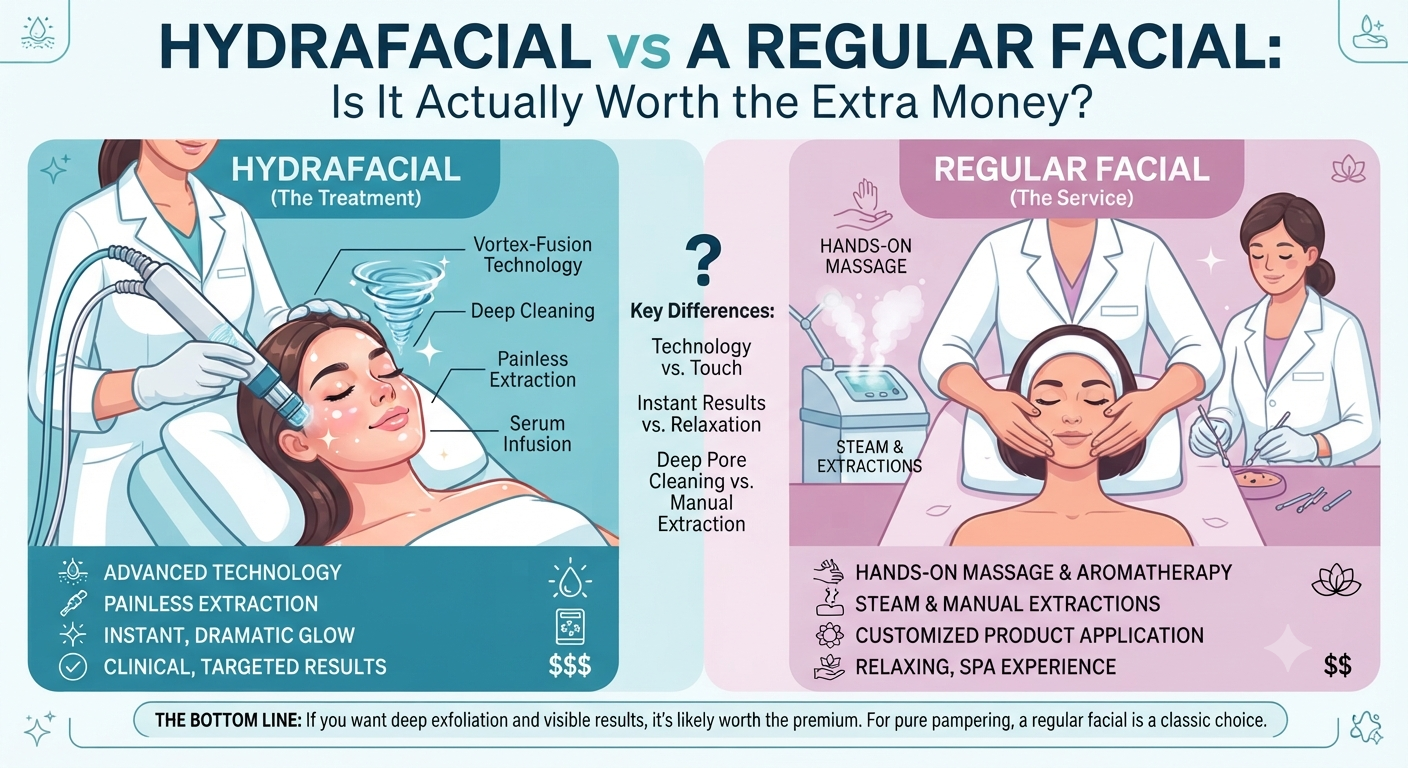
If you've looked at a salon menu and noticed a HydraFacial costs considerably more than a "classic" or "deep cleansing" facial, the obvious question is whether you're paying for a genuinely better treatment or just a trademarked name and a fancier machine. The honest answer is a bit of both — there are real differences, but whether they justify the price gap depends entirely on what you're actually trying to achieve.
First, a quick clarification: HydraFacial is a brand
This trips a lot of people up. "HydraFacial" isn't a generic type of treatment — it's a specific patented brand of machine and process, in the same way "Hoover" is a brand rather than a word for all vacuum cleaners. Only providers using the official HydraFacial device can technically call it that. Plenty of salons offer similar "hydradermabrasion" treatments under other names, which may use comparable technology — so if a menu lists a HydraFacial specifically, you're paying partly for that branded, standardised process.
How a regular facial actually works
A traditional facial (sometimes listed as a classic, European or deep cleansing facial) is a multi-step, largely manual treatment performed by a therapist: cleansing, exfoliation, steam, manual extractions, massage, and a mask, usually finishing with serums and moisturiser. It's genuinely relaxing, tends to run around an hour, and can be tailored on the spot to your skin by a skilled therapist.
The trade-off is consistency. Because so much of a traditional facial depends on the individual therapist's technique and the products the salon uses, the quality can vary noticeably from one provider to the next — and manual extractions can leave some redness afterward, particularly on sensitive skin.
How a HydraFacial works differently
A HydraFacial uses a device with a spiral treatment tip that combines exfoliation, extraction and serum infusion into one step using a vortex-style suction, rather than relying on manual extraction. It's typically quicker (around 30–45 minutes), and because the extraction is done by gentle suction rather than manual pressure, most people find it more comfortable with little to no redness or downtime afterward.
The other genuine advantage is standardisation: because the process is device-driven, you tend to get a more consistent result regardless of which therapist performs it, which isn't something a manual facial can promise in the same way.
Side by side
HydraFacial Regular Facial
| Method | Device-based (suction + serum infusion) | Mostly manual technique
| Typical time | 30–45 minutes | Around 60 minutes
| Results | Immediate, visible glow | More gradual, varies by therapist
| Downtime/redness | Minimal | Possible mild redness after extractions
| Experience | Efficient, clinical | Relaxing, spa-like
| Cost | Higher | More affordable
The thing most comparisons skip: consistency beats treatment type
Here's the point that genuinely matters more than which treatment you pick. The single biggest factor in facial results isn't HydraFacial versus regular — it's how consistently you go. Someone getting a regular monthly facial will almost always see better skin over a year than someone getting one premium HydraFacial every six months. Your skin renews itself roughly every 28–40 days, which is exactly why monthly is often described as the sweet spot for either treatment. Booking whichever one you'll actually keep up with monthly matters more than paying more for a one-off.
So which should you actually book?
Go with a HydraFacial if you want quick, visible, consistent results with no downtime, you're targeting specific concerns like congestion, dullness, enlarged pores or uneven tone, or you have sensitive skin that reacts to manual extractions. It's also a popular choice before an event for an immediate glow.
Go with a regular facial if you want a relaxing, pampering experience as much as a skin result, you're on a tighter budget and would rather go more frequently, or you have a very specific skin condition that benefits from a skilled therapist's hands-on customisation.
Worth knowing: the two aren't mutually exclusive, and some people alternate — a HydraFacial when they want visible results before something specific, regular facials in between for maintenance and relaxation. If your main concern is texture and peach fuzz rather than congestion, our guide to dermaplaning vs microdermabrasion vs chemical peel covers exfoliation-focused options that are sometimes combined with a HydraFacial in the same visit.
What it actually costs in the UK
Based on real pricing data submitted across the UK, you can check current rates on our HydraFacial price page, our classic facial price page, and our deep cleansing facial price page to see the actual gap in your area rather than assuming it. Because consistency matters so much, our pricing calculator can help you work out the realistic annual cost of a monthly routine with either option — which is often a more useful number than the one-off price when deciding what you'll actually stick to.
The bottom line
A HydraFacial isn't automatically "better" than a regular facial — it's a more standardised, quicker, results-focused treatment, while a traditional facial is more relaxing and more dependent on the therapist. The extra cost is genuinely worth it for some goals and unnecessary for others. Whichever you choose, going consistently will do far more for your skin than paying more for something you only book occasionally.
Find a verified skincare specialist near you in our directory, or check current UK pricing for facials and skincare treatments on our Beauty Price Index.
Ready to book skincare?
Check typical UK prices, then find a verified local pro.