Dermaplaning vs Microdermabrasion vs Chemical Peel: What's Actually the Difference?
4 min read · Updated 5 Aug 2026
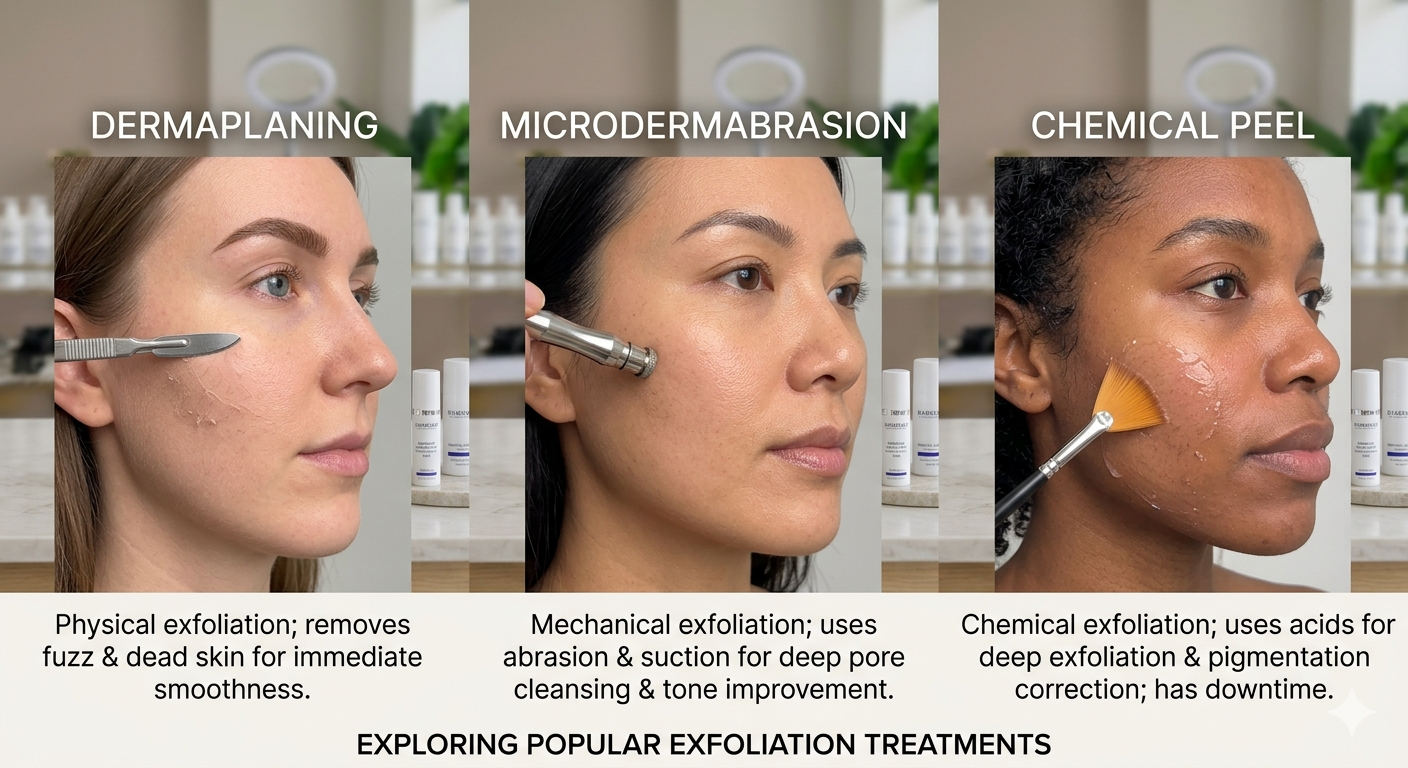
Walk into pretty much any skincare clinic or beauty salon menu and you'll see dermaplaning, microdermabrasion and chemical peels sitting next to each other, all promising some version of "smoother, brighter, more even skin." They're often talked about as interchangeable options for the same goal, but the way they actually achieve that result couldn't be more different — one uses a blade, one uses a machine, and one uses chemistry. Picking based on price alone, without understanding the mechanism, is how people end up disappointed with results that were never going to address what they actually wanted fixed.
Three different methods, three different goals
Dermaplaning uses a surgical-grade blade to gently scrape away the very top layer of dead skin cells along with vellus hair (the fine "peach fuzz" on your face). It's purely physical exfoliation with no chemicals and no machine — just a blade and a steady hand. There's no downtime, results are immediate, and it's one of the few treatments that also removes facial hair, which is part of why it's popular before makeup-heavy events.
Microdermabrasion also exfoliates physically, but with a handheld device rather than a blade — either fine crystals or a diamond-tipped wand, combined with suction that vacuums away the loosened dead skin. It goes slightly deeper than dermaplaning in terms of cell turnover, but unlike dermaplaning, it doesn't touch facial hair at all.
Chemical peels work completely differently — there's no physical scraping or buffing involved. Instead, an acid solution (commonly glycolic, lactic, salicylic or TCA, depending on strength) is applied to break down and lift away the damaged outer layers of skin chemically. Because the depth can be controlled by the acid type and concentration, peels range from a very light "lunchtime peel" with no visible downtime to deeper peels that involve genuine peeling and several days of recovery.
Side by side
Dermaplaning Microdermabrasion Chemical Peel
| Method | Blade | Crystals/diamond tip + suction | Chemical solution
| Removes facial hair | Yes | No | No
| Downtime | None | None to minimal | None to several days (depends on depth)
| Good for acne/pigmentation | Limited | Mild cases only | Most effective of the three
| Best for | Texture, peach fuzz, instant glow | General dullness, mild texture | Pigmentation, acne, deeper texture concerns
Which one actually helps with which concern
This is where most comparison articles get vague, so here's the more direct version:
If your main complaint is texture and dullness with otherwise healthy skin, dermaplaning or microdermabrasion will likely give you a visible improvement with zero downtime — dermaplaning if you also want the facial hair removed, microdermabrasion if you don't.
If you're dealing with pigmentation, acne scarring or more stubborn skin tone issues, a chemical peel is generally the more effective route, since the acid can actually penetrate beyond the very surface layer that physical exfoliation reaches. The trade-off is the potential for some redness, sensitivity or visible peeling afterward, depending on the strength used.
If you have active inflammatory acne, physical exfoliation (both dermaplaning and microdermabrasion) can sometimes aggravate it, since you're physically buffing or scraping over inflamed skin. A peel formulated for acne (often using salicylic acid) is usually the better-suited option, but this is genuinely worth discussing with whoever's treating you rather than guessing.
A few things worth knowing before booking any of them
- Sun protection afterward isn't optional. All three treatments remove protective surface layers of skin, which leaves it more sensitive to UV damage for some time afterward. SPF the next day (and ideally for the following week or two) genuinely matters, not just as general advice.
- Peels vary enormously in strength. "Chemical peel" covers everything from a gentle weekend-friendly treatment to something with several days of visible peeling. Always ask specifically what strength and acid is being used rather than assuming all peels are the same intensity.
- These can be combined, just not on the same day. It's common for a dermaplaning session to happen before a peel on a separate visit, since clearing surface buildup first can help the peel work more evenly. Doing both in one sitting tends to be too much for the skin at once.
The bottom line
Dermaplaning and microdermabrasion are both physical exfoliation with no real downtime, best suited to texture and a general glow rather than deeper concerns. Chemical peels go further and can genuinely shift pigmentation and acne scarring, but come with a wider range of intensity and recovery time depending on strength. The right one depends far more on what you're actually trying to fix than on which treatment sounds the most high-tech on the menu.
Find a verified skincare specialist near you in our directory, or check typical UK pricing for skincare treatments on our Beauty Price Index.
Ready to book skincare?
Check typical UK prices, then find a verified local pro.