Ads
The Patch Test Isn't Your Salon Being Awkward — It's a Legal Requirement (and an Insurance One)
 Roylina Team
Gold · 4,110 lifetime points
Verified UK Pro — qualified & insured
Premium Lovers account
Premium Gold account
1 month ago
106
4 min
Roylina Team
Gold · 4,110 lifetime points
Verified UK Pro — qualified & insured
Premium Lovers account
Premium Gold account
1 month ago
106
4 min
Also Read:
Added up what I spend on beauty in a year and I've been sat here in silence for ten minutes
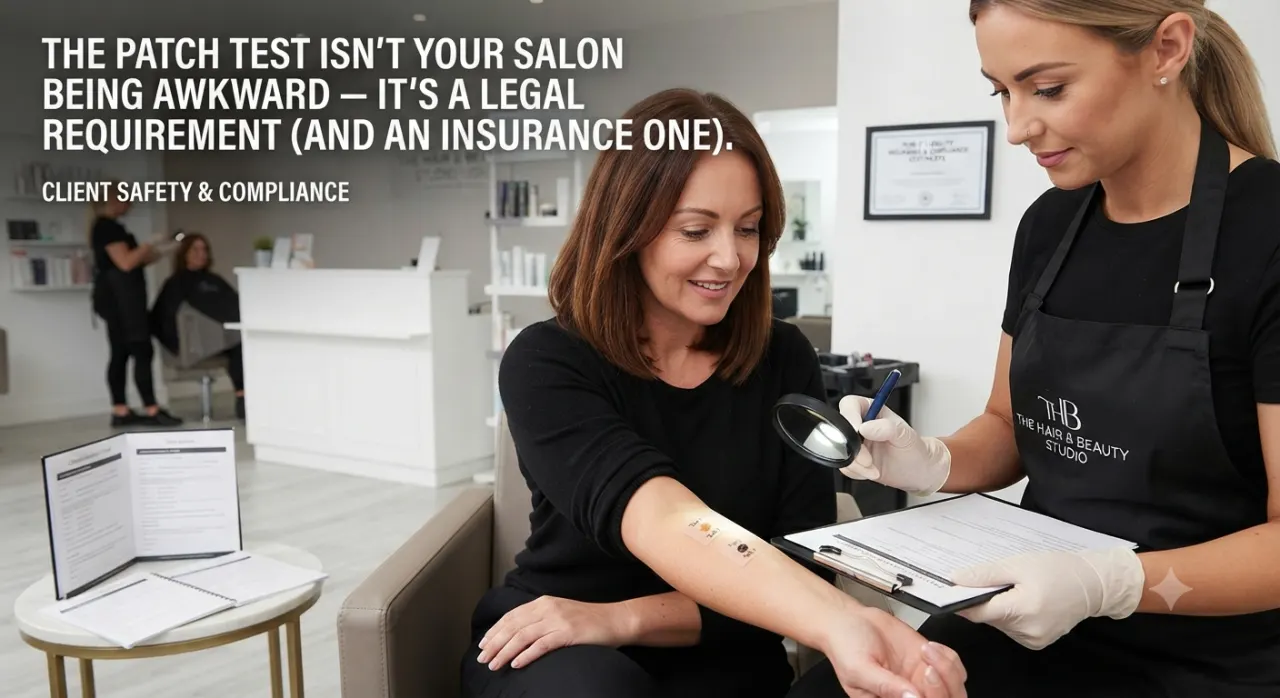
You've booked a colour appointment, and the salon asks you to pop in two days beforehand for a five-minute dab of product behind your ear. It's genuinely annoying — an extra trip for something that feels like paperwork. So it's worth knowing what's actually going on, because the patch test is one of the few things in a salon that isn't discretionary, isn't marketing, and isn't the salon being difficult. In hairdressing it's a legal requirement, and across the board it's usually a condition of the salon's insurance.
What it's actually testing for
The main culprit in hair colour is PPD (paraphenylenediamine) — the ingredient that produces natural-looking permanent colour, and the cause of most reactions to hair dye. Darker shades contain more of it. Reactions range from an irritated, inflamed scalp to genuinely serious whole-body allergic responses.
The part that catches people out: you can develop this allergy at any time, including after years of colouring with no issues whatsoever. Previous appointments prove nothing about the next one, which is precisely why salons retest rather than relying on your history.
The black henna tattoo warning
Worth flagging on its own because it's the single biggest risk factor most people don't know about. So-called "black henna" temporary tattoos — the kind sold at markets and holiday resorts — often contain very high concentrations of PPD. Getting one can sensitise you dramatically, turning a previously fine relationship with hair dye into a serious allergy. If you've ever had one, tell your stylist, even if it was years ago and even if nothing happened at the time.
It isn't just hair colour
Patch testing applies across far more of the treatment menu than most clients realise:
- Hair colour — permanent and many semi-permanent systems.
- Lash extensions — the adhesive, 24–48 hours before a first set.
- Lash and brow tints — dye near the eyes.
- Brow lamination — a thioglycolate solution, same chemical family as perms.
- Henna brows — plant-based doesn't mean allergen-free.
Which means: if you're booking a first appointment for any of these before an event, you need two visits, not one. Book the patch test the moment you book the treatment.
The rules salons are actually working to
For hairdressers, patch testing before colour is a legal duty under Section 3 of the Health and Safety at Work Act — the provision requiring businesses to conduct their work so that people other than their own staff aren't exposed to health risks. Beyond the law, salon insurers require it: a consultation and the relevant industry tests must be completed before chemical services, records kept and signed, typically retained for six years.
That last detail is the one worth absorbing. A salon that skips your patch test to fit you in may be operating without valid insurance cover for that appointment. If something goes wrong, that's your problem as much as theirs.
Most salons treat a test as valid for around six months, some twelve. Returning regularly for the same service with the same product often means no retest — but a gap of six months or more, a change of product, or any new sensitivity resets that.
What to do if you react
Wash the area thoroughly, don't proceed with the treatment, and tell the salon straight away. A reaction doesn't necessarily mean you can never colour your hair again — but it does mean the safe route changes, and any decent salon will discuss alternatives rather than pressing ahead. If the reaction is more than mild irritation, speak to your GP, and mention PPD specifically so it's on your record.
The red flag, stated plainly
If a salon doesn't mention a patch test when one is required — especially for a first-time client, a first-time treatment, or after a long gap — that's a meaningful signal about their standards generally. Not because the test itself is dramatic, but because it's the easiest corner to cut, and a business cutting the legally required corner is probably cutting others you can't see. "Do I need a patch test?" is a completely normal booking question, and how confidently it's answered tells you a lot.
The bottom line
Patch tests exist because allergies can appear out of nowhere, the consequences can be serious, and the law and insurers both require them. They apply to colour, lashes, tints, lamination and henna — so first-time bookings need two visits, planned around your event. Mention any black henna tattoos, ever. And treat a salon that skips the test not as convenient, but as careless.
Find a verified beauty professional near you in our directory, or compare current UK treatment prices on our Beauty Price Index.
Choice Community
0 Comments
Join the conversation.
Log in to comment
No comments yet. Be the first to share your thoughts.