Ads
Why It's Getting Harder to Book Your Favourite Stylist — the Quiet Crisis Behind the Waiting Lists
 Roylina Team
Gold · 4,112 lifetime points
Verified UK Pro — qualified & insured
Premium Lovers account
Premium Gold account
1 month ago
105
5 min
Roylina Team
Gold · 4,112 lifetime points
Verified UK Pro — qualified & insured
Premium Lovers account
Premium Gold account
1 month ago
105
5 min
Also Read:
Added up what I spend on beauty in a year and I've been sat here in silence for ten minutes
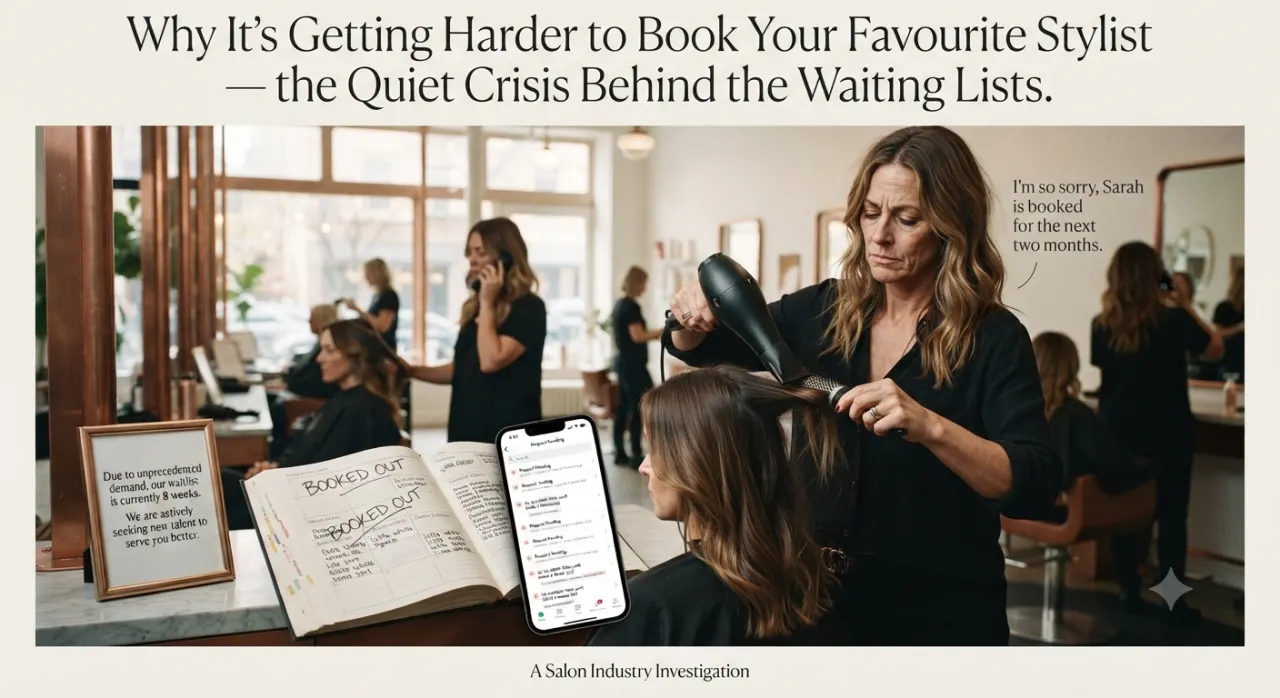
If your usual stylist's waiting list has quietly stretched from two weeks to six, or your salon has put prices up twice in eighteen months, there's a structural reason behind it that rarely gets explained to clients. The UK hair and beauty industry is running out of new professionals — and the numbers are genuinely stark.
The numbers
Hairdressing apprenticeship enrolments have dropped by 70% over the past decade. Salon owners report it now takes an average of 16 weeks to fill a single vacancy, with some describing hiring qualified stylists as almost impossible. Meanwhile hair salons in Great Britain have been closing at a net rate of roughly 300–400 per year, and an NHBF survey this year found one in five UK hair and beauty businesses operating at a loss — busy with clients, but not profitable once wages, energy and overheads are counted.
The result is an acute shortage of senior stylists building through 2026 and beyond, because the people who would be senior in 2030 didn't start training in 2020.
Why it happened
Several things stacked up at once. Young people increasingly perceive hairdressing as low-paid — an apprentice wage sits around £14,000–£15,700 for the first year, which is a hard sell against other entry-level options. More school leavers now choose college courses over apprenticeships, which salon owners consistently say is no substitute for learning on the salon floor with real clients.
Then there's the economics on the employer side. Rising employment costs — including a 4.1% National Living Wage increase from April 2026 and new obligations under the Employment Rights Act — have made taking on an apprentice financially prohibitive for many small salons. As the NHBF puts it, when micro-businesses go into survival mode, training is the first thing paused.
And the biggest structural shift of all: the move to self-employment. Chair renters and home-based professionals now make up an enormous share of the industry — and self-employed pros rarely train juniors, because there's no business model that pays them to. The traditional apprenticeship pipeline ran through salons that employed staff; as that model shrinks, so does the pipeline.
What it means if you're a client
- Book further ahead. Rebooking as you leave the chair is genuinely becoming the only reliable way to keep a slot with an in-demand stylist. Waiting lists aren't going to shorten.
- Price rises aren't greed. Fewer professionals plus higher costs plus one in five businesses running at a loss is a maths problem, not a cash grab. Our guide to what haircuts actually cost breaks down where the money goes.
- Junior and graduate stylists are the underrated option. They're qualified, supervised, typically 20–40% cheaper, and often have far better availability. They also badly need clients to build on — booking one is genuinely how the next generation gets made.
- Home-based and independent pros are absorbing the demand. If your salon can't fit you in, the independent sector is where the capacity has moved — our directory lists verified professionals near you.
What it means if you're a professional
If you employ or are thinking about it, the funding position has changed meaningfully for 2026 and it's worth knowing:
- Up to £8,000 in potential support per apprentice hire, depending on eligibility — including £1,000 for recruiting apprentices aged 16–18, £2,000 in Foundation Apprenticeship support, and an additional £2,000 SME recruitment incentive from 2026.
- Full NIC exemption for all apprentices under 25.
- The £1bn Youth Guarantee applies to apprenticeships starting from 1 October 2026, paid in two instalments at day 90 and day 365.
- Payments are staged early rather than at the end, which matters for cash flow when you're the one investing the training time.
None of that makes hiring easy, and the sector's own bodies are still lobbying on business rates (salons didn't get the 15% relief granted to pubs and music venues). But the "I'd love to train someone but can't afford to" calculation is genuinely different in 2026 than it was in 2024 — worth rerunning if you last looked a couple of years ago.
The bit that gives some cause for optimism
The industry isn't shrinking overall — it's reshaping. While hair salons close, more than a thousand beauty salons and nail bars were added in a single year, and consumer spending on health and beauty rose 7.3% year on year. Nail bars and low-overhead micro-businesses are the fastest-growing high-street category. The demand is there. What's broken is the training route into it — and that's a fixable problem rather than a dying trade.
The bottom line
Longer waits and rising prices aren't your salon being difficult — they're the visible edge of a 70% collapse in apprenticeship training and a squeeze that has one in five businesses running at a loss. Book ahead, consider a junior stylist, and if you're a professional who's been putting off taking on an apprentice, the 2026 funding is worth another look. The industry's next generation is currently a policy problem; it doesn't have to stay one.
Find a verified beauty professional near you in our directory, or compare current UK treatment prices on our Beauty Price Index.
Choice Community
0 Comments
Join the conversation.
Log in to comment
No comments yet. Be the first to share your thoughts.