LED Light Therapy: What It Actually Does, and What It Costs in the UK
5 min read · Updated 16 Sep 2026
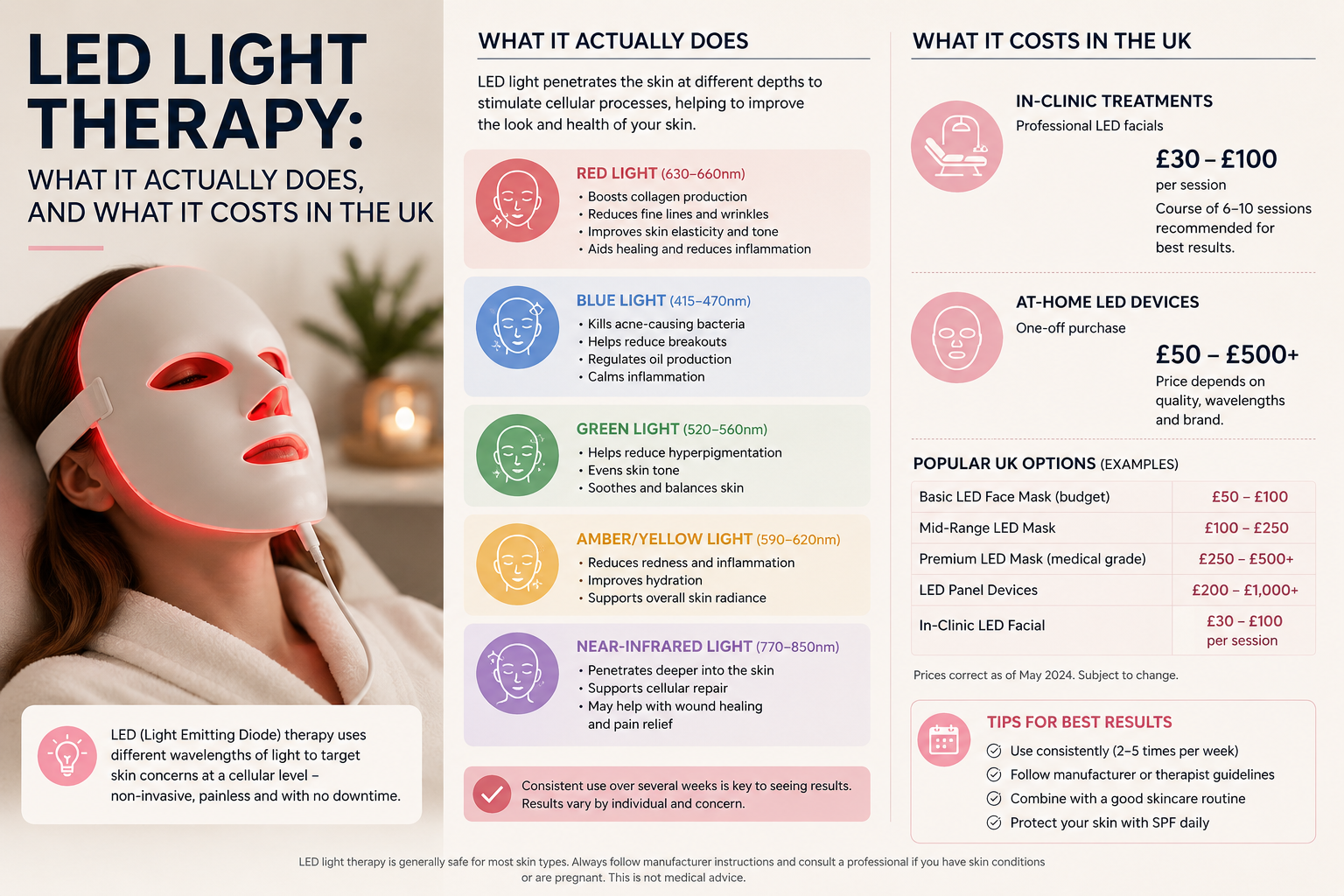
LED light therapy has quietly gone from a niche facial add-on to one of the fastest-growing treatments in UK skincare — searches for red light therapy jumped over 300% in the past year, and it's now everywhere from high-street salons to at-home masks. But most explanations either drown you in wavelength jargon or skip the single most important fact about this treatment: it's cumulative, and one session on its own does very little. Here's the honest, practical version.
What LED light therapy actually is
LED (light emitting diode) therapy exposes your skin to specific wavelengths of light that trigger biological responses in skin cells — the technology was originally researched by NASA for tissue repair and later used medically for wound healing before making its way into skincare. There are no needles, no chemicals, no UV (it's completely different from sun exposure or tanning beds), and no downtime. You sit or lie under a light panel, usually with protective eyewear, for around 20–30 minutes, and it's genuinely painless — most people find it relaxing.
What the different colours actually do
This is where the marketing gets confusing, so here's the plain-English version of the three main wavelengths:
Light What it targets Best for
| Blue (~415nm) | Acne-causing bacteria on the skin's surface | Active breakouts, congested skin
| Red (~633nm) | Collagen and elastin production | Fine lines, firmness, general glow
| Near-infrared (~830nm) | Deeper healing, circulation, inflammation | Redness, pigmentation, skin repair
Many professional devices combine two or three of these in one session, which is why LED is often pitched as treating "everything" — it's less that one light does everything and more that different wavelengths are being layered to cover different concerns at once.
The part clinics don't always say clearly: it's cumulative
Here's the most useful thing to understand before spending any money. LED results build over a course of regular sessions — the light stimulates cellular processes that develop over weeks, not in a single sitting. A typical professional protocol is one or two sessions a week for somewhere between four and ten weeks, followed by occasional maintenance sessions every month or two afterwards. In one clinical trial of a professional LED device, around 80% of participants reported improved skin texture and 66% improvement in wrinkles — but that was after four weeks of treatment, not one appointment.
A one-off session will leave your skin looking a bit brighter and more hydrated that day, which is pleasant but temporary. If a single session is all you're planning, it's worth knowing upfront that you're buying a nice glow for an event, not a lasting skin change. The lasting results live in the course.
What it costs in the UK
Professional LED sessions in the UK typically run somewhere between £30 and £90 depending on the clinic and region, with premium London clinics reaching £150 for targeted facial treatments. Brand-name systems like Dermalux commonly start around £55 as a standalone session, or around £45 when added onto another treatment. Because a proper course involves multiple weekly sessions, most clinics offer packages that cut the per-session price by 10–30% — and given that consistency is what actually delivers results, a bundle is usually the sensible way to buy this treatment rather than paying session by session.
You can check what people are actually paying near you on our LED light therapy price page, and use our pricing calculator to work out the realistic cost of a full course plus maintenance rather than just the single-session figure.
LED as an add-on (where it genuinely earns its keep)
One of the most cost-effective ways to use LED is as an add-on to other treatments rather than a standalone course. It pairs particularly well after treatments like a HydraFacial, microneedling or a facial, where the light's healing and anti-inflammatory effects help calm the skin and enhance the result of the main treatment — usually at a reduced add-on price. If you're already getting regular facials, asking about an LED add-on is often a better-value entry point than booking a separate course from scratch.
Who should be cautious
LED is one of the safest treatments in skincare — suitable for essentially all skin types and tones, painless, with no downtime beyond occasional mild, short-lived redness. The main genuine caution is medication: certain medications that increase light sensitivity, most notably Accutane (isotretinoin), don't mix with LED therapy. If you're on any medication that affects your skin or light sensitivity, mention it at your consultation before booking a course. A reputable clinic will ask anyway.
What about at-home LED masks?
They're everywhere, and the honest answer is: they work on the same principle but at lower power. Professional panels deliver significantly higher light intensity than most consumer masks, which is why clinic results come faster. A quality home device used consistently (several times a week, over months) can absolutely deliver real results — but consistency matters even more at lower power, and cheap uncertified devices often lack the output to do much at all. If you're choosing between a bargain mask and a course of professional sessions, the professional course is the more reliable spend.
The bottom line
LED light therapy is genuinely effective, genuinely safe, and genuinely pleasant — but only if you go in understanding that it's a course-based treatment, not a one-off fix. Blue light for breakouts, red for collagen and fine lines, near-infrared for deeper repair. Budget for a package of weekly sessions rather than a single appointment, or start with it as an add-on to a facial you're already having, and judge the results after a month rather than a day.
Find a verified skincare specialist offering LED therapy near you in our directory, or check current UK pricing on our Beauty Price Index.
Ready to book skincare?
Check typical UK prices, then find a verified local pro.