Microneedling: What It Actually Does (and When a Chemical Peel Is the Better Choice)
5 min read · Updated 16 Sep 2026
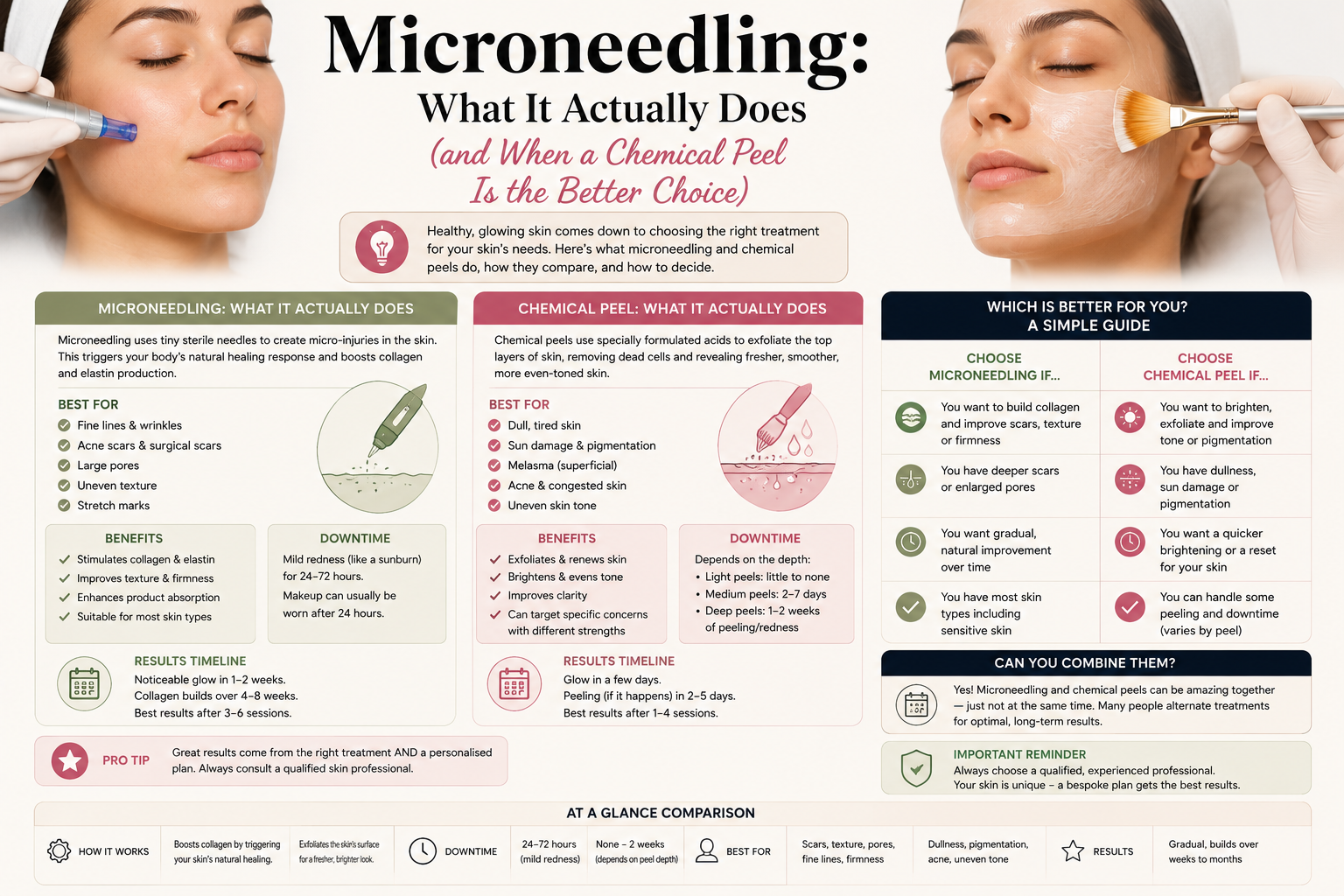
Microneedling sounds like something you'd need convincing to try — deliberately puncturing your face with hundreds of tiny needles — and yet it's become one of the most requested skin treatments in UK clinics, particularly for acne scarring. The interesting question isn't whether it works (it does, for the right concerns), but whether it's the right tool for your concern, because for some things a chemical peel does the job faster and cheaper. Here's the honest comparison.
What microneedling actually does
A device with fine, sterile needles creates thousands of controlled micro-injuries in the skin. That sounds counterproductive, but it's precisely the point: the micro-injuries trigger your skin's natural repair response, ramping up collagen and elastin production from within. Over the following weeks, that new collagen gradually smooths texture, softens fine lines, and — most notably — fills in indented acne scars, which is where microneedling genuinely earns its reputation.
The session itself is more tolerable than it sounds: numbing cream goes on first, and most people describe the sensation as prickling or vibration rather than pain. Expect a day to three of redness afterwards, like mild sunburn, and then normality. The catch is patience — because collagen takes time to build, results develop gradually over weeks and months, with the most visible improvement typically emerging 4–6 weeks after each session and continuing for months.
The one-session myth
The most important expectation to set: microneedling is a course-based treatment, not a one-off fix. Most people need 3–6 sessions spaced 4–6 weeks apart for meaningful results, with more severe scarring sometimes needing more. A single session gives your skin a temporary glow and starts the collagen process, but if a clinic sells you one session as a solution for acne scars, that's setting you up for disappointment. Budget for the course, not the appointment — the same logic as LED light therapy, and for the same biological reason: you're paying for a process your skin does over time, not an instant change.
Microneedling vs chemical peel: which for which concern
These two get compared constantly because they overlap on the menu but work from opposite directions — a peel exfoliates from the surface down, microneedling rebuilds from the inside out. That difference decides which one suits which problem:
Microneedling Chemical Peel
| Works by | Collagen stimulation from within | Exfoliating surface layers
| Best for | Indented acne scars, texture, pores, fine lines | Pigmentation, sun damage, dullness, surface-level lines
| Speed of results | Gradual, over 3–6 months | Visible after one peel (light peels)
| Typical course | 3–6 sessions, 4–6 weeks apart | 1 for a refresh; 3–6 for deeper concerns
| Downtime | 1–3 days redness | 3–7 days peeling (longer for deep peels)
| Darker skin tones | Safe — minimal pigmentation risk | Deeper peels carry hyperpigmentation risk
Two takeaways worth pulling out of that table. First, if your concern is pigmentation or sun damage, a peel is usually the more direct tool; if it's textural — indented scars, uneven surface, enlarged pores — microneedling reaches where peels can't. In one clinical comparison on acne scarring, around 73% of microneedling patients saw significant improvement versus 35% with a glycolic acid peel. Second, skin tone genuinely changes the answer: microneedling carries minimal risk of post-inflammatory hyperpigmentation, which makes it the safer choice for darker skin tones, where deeper chemical peels can cause the very discolouration you're trying to fix.
What it costs in the UK
Microneedling in the UK typically runs £150–£350 per session depending on the clinic, the device used and the area treated. Chemical peels span a wider range — from around £80 for a light "lunchtime" peel up to £500+ for advanced deep peels. Because microneedling needs a course of 3–6 sessions, the realistic total for a proper treatment plan lands somewhere between £450 and £2,000 — which is why many clinics offer course bundles at a meaningful discount, worth asking about before paying per session. You can check what people are actually paying near you on our microneedling price page and chemical peel price page, and work out the full course cost with our pricing calculator.
Can you combine them?
Yes — and it's increasingly common as a planned sequence rather than a same-day double-up. The usual approach alternates or staggers the two a couple of weeks apart, letting the peel handle surface renewal while microneedling works on deeper structure. Doing both on the same day is generally avoided as it risks excessive irritation. If a practitioner suggests a combined plan, that's legitimate; if they suggest both in one sitting, ask more questions.
Who should be cautious
Microneedling is broadly safe across skin types and tones, but it's worth postponing if you have active acne breakouts in the treatment area (needling over active inflammation can spread it), active skin infections, or you're pregnant or breastfeeding — most clinics will advise waiting. As with any skin-breaking treatment, hygiene standards matter enormously: this should be done with sterile, single-use needle cartridges in a clean clinical setting, not as a casual add-on with reused equipment. And skip active ingredients like retinoids for about a week either side of a session — your practitioner should brief you on this, and it's a small green flag if they do so unprompted.
The bottom line
Microneedling is the better tool for texture: indented acne scars, enlarged pores, uneven surface, fine lines — and it's the safer option for darker skin tones. A chemical peel is the better tool for surface concerns: pigmentation, sun damage and dullness, with faster visible results. Both are course-based treatments, so budget £450–£2,000 for a proper microneedling plan rather than judging by the single-session price, and be suspicious of anyone selling either as a one-appointment fix.
Find a verified skincare specialist near you in our directory, or check current UK pricing for skin treatments on our Beauty Price Index.
Ready to book skincare?
Check typical UK prices, then find a verified local pro.