Microblading vs Brow Lamination vs Henna Brows: Which One Actually Suits You?
5 min read · Updated 1 Aug 2026
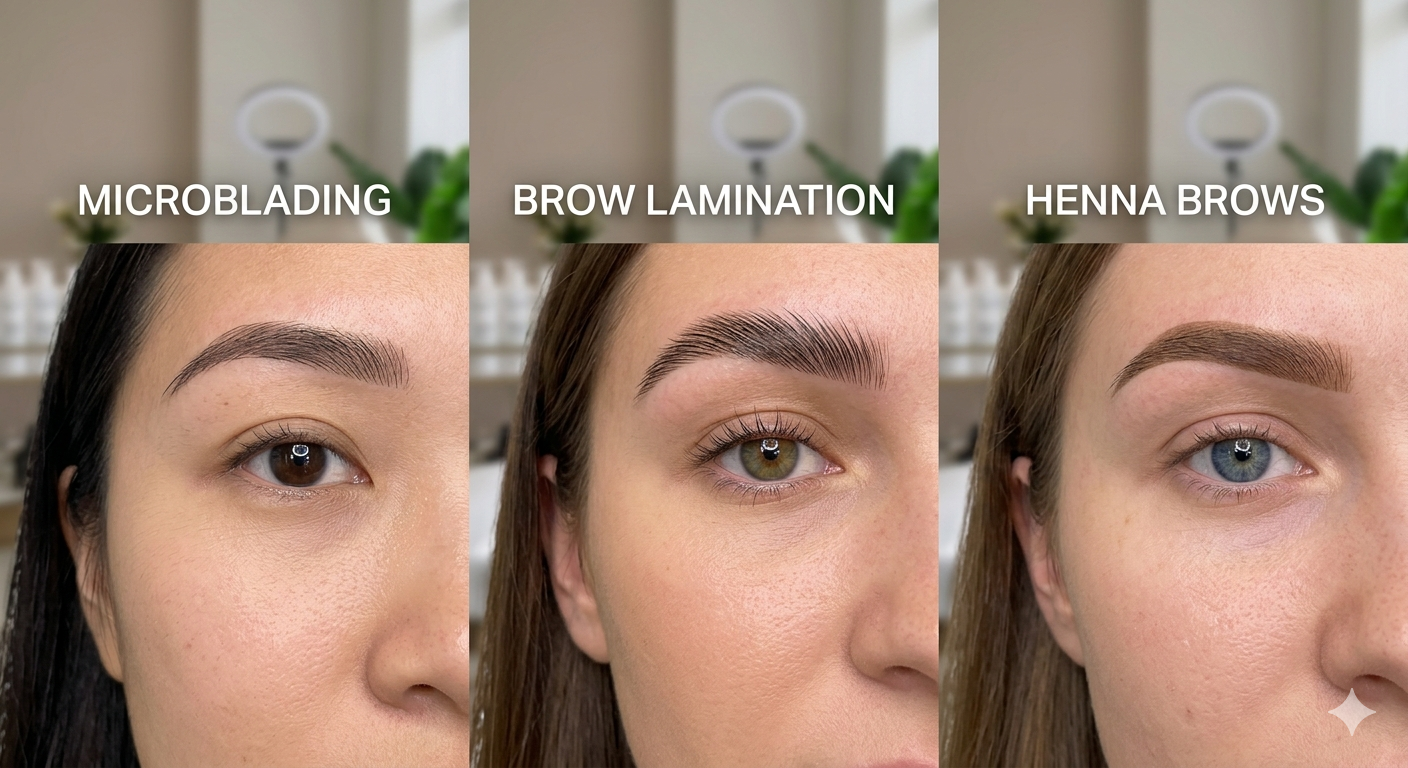
Brow treatments have multiplied fast over the last few years, and microblading, lamination and henna all tend to get lumped together as "the brow thing everyone's getting" — even though they're genuinely different treatments solving different problems. One involves needles and lasts years. One is closer to a perm for your eyebrow hairs. One is a plant-based dye that washes out in weeks. Mixing these up before you book is an easy way to end up with the wrong result for what you actually wanted.
The fundamental difference, in one line each
- Microblading adds pigment under the skin to create hair-like strokes — it's a form of semi-permanent tattoo.
- Brow lamination doesn't add anything — it restyles your existing brow hairs into a fuller, more lifted shape.
- Henna brows stains both the hairs and the skin underneath with a plant-based dye — no needles, no restyling, just colour.
Once you separate them by what they actually do — tattoo, restyle, or dye — the rest of the decision gets a lot easier.
Microblading: the most permanent of the three (and that's worth taking seriously)
Microblading uses a handheld tool with tiny needles to deposit pigment into the upper layer of skin, creating fine strokes that mimic individual brow hairs. It's genuinely effective for very sparse or patchy brows, since it can recreate hair where there isn't much natural hair left to work with.
Here's the part that often gets glossed over in salon marketing: microblading is a cosmetic tattoo, not a temporary treatment. Pigment can remain in the skin for years — some people keep results for 2–3 years before it fades enough to need a fresh treatment, and in some cases pigment never fully disappears, it just changes. That's the trade-off for the longevity: it's harder and more expensive to correct if you don't like the shape, the colour can shift over time (sometimes going slightly orange, blue or grey as it ages), and it's genuinely invasive in a way the other two options simply aren't.
If you're considering it, ask your artist directly about healing time (typically 10–14 days before it looks settled, with the colour continuing to soften for several weeks after that), their experience with different skin types, and what correction options exist if you're not happy with the initial result.
Brow lamination: working with what you've already got
Lamination doesn't add pigment or hair — it uses a gentle chemical solution to relax your existing brow hairs, then resets them in a smoother, more lifted direction before conditioning them back into place. If your natural brow hair grows downward, sticks out at odd angles, or is patchy in a way that makes the brow look thinner than it is, lamination can make a noticeable difference just by redirecting the hair you already have.
Results typically last 4–8 weeks, roughly tracking your natural hair growth cycle, and it's generally cheaper than microblading. It's also reversible in the sense that there's nothing permanent happening to your skin — if you don't love it, you simply wait for it to grow out.
Henna brows: colour without commitment
Henna brows use a natural plant-based dye that stains both the brow hairs and the skin underneath, which is what gives henna brows their fuller, more defined look compared to a standard tint (which only colours the hair, not the skin). Because there's no needle involved at any point, it's the least invasive of the three by a clear margin.
The trade-off is longevity: the stain on the skin typically fades within 1–2 weeks, while colour on the hairs themselves can last several weeks longer. It's a good option if you want to trial a fuller brow shape before committing to anything more permanent, or if you have sensitive skin and want to avoid the chemicals used in standard tinting.
Side by side
Microblading Brow Lamination Henna Brows
| Involves needles | Yes | No | No
| Typical duration | 1–3 years | 4–8 weeks | 1–2 weeks (skin), longer on hair
| Adds pigment under skin | Yes | No | No (surface stain only)
| Reversible if you dislike it | Difficult | Easy (grows out) | Easy (fades out)
| Best for | Very sparse/patchy brows | Unruly, downward-growing hair | Trialling fullness, sensitive skin
So which one should you actually book?
Go with microblading if your brows are genuinely very sparse, you've thought it through properly, and you're comfortable with a result that will be with you for a year or more — not something to book on a whim before a holiday.
Go with lamination if you actually have enough brow hair, it just doesn't sit the way you want it to. It's the lowest-commitment option of the three if you're not sure and want to see a difference without anything semi-permanent.
Go with henna if you want more definition and fullness temporarily, you have sensitive skin, or you simply want to test out a bolder brow before considering anything longer-lasting.
A good brow technician should be asking about your hair growth pattern, your skin sensitivity, and how much natural brow hair you're starting with before recommending any of these — if a consultation skips straight to "which one do you want," it's worth asking a few questions yourself before committing.
Find a verified brow specialist near you in our directory, or check typical UK pricing for brow treatments on our Beauty Price Index.