Ads
Your Hair Is About to Start Shedding More — Here's Why, and When It's Actually Worth Worrying
 Roylina Team
Gold · 4,112 lifetime points
Verified UK Pro — qualified & insured
Premium Lovers account
Premium Gold account
1 month ago
74
5 min
Roylina Team
Gold · 4,112 lifetime points
Verified UK Pro — qualified & insured
Premium Lovers account
Premium Gold account
1 month ago
74
5 min
Also Read:
Added up what I spend on beauty in a year and I've been sat here in silence for ten minutes
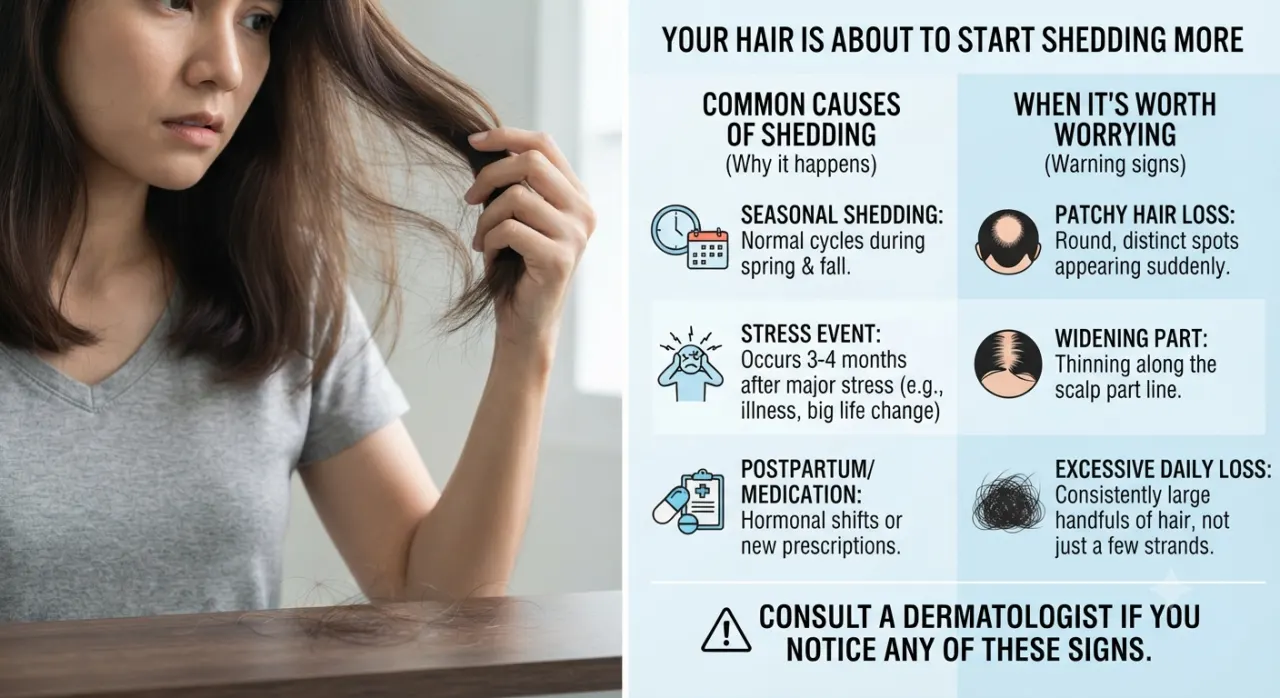
If you're about to spend six weeks quietly panicking about the amount of hair in your shower drain, this is your early warning: autumn shedding is real, it's already starting, and for most people it peaks in September. It catches people out every year — and because most of what's written about it is published by companies selling hair supplements, the honest version is surprisingly hard to find. Here it is, without anything to sell you.
What's actually happening
Your hair works in cycles: growing, resting, then shedding to make room for new growth. Normally 10–15% of your hairs sit in the resting (telogen) phase at any time, which works out to the familiar 50–100 hairs a day.
The seasonal part comes down to timing. More follicles enter the resting phase during summer — possibly a leftover protective mechanism, keeping hair denser over the scalp through the sunniest months. Resting hairs stay dormant for roughly 100 days before releasing. Do the maths from a July peak and you land in September to November — which is exactly when studies consistently find shedding peaks in the UK and Europe. Roughly 1 in 20 adults notices it enough to be bothered by it.
What's normal (and what isn't)
The reassuring version: normal seasonal shedding is diffuse — spread evenly across your whole head rather than concentrated in patches. It typically runs 6–8 weeks, can temporarily double your daily hair fall (150–200 hairs on heavy days), and resolves on its own within two to four months. Because the follicles stay intact, the hair grows back without any treatment at all.
Worth getting checked if any of these apply: shedding that's still heavy after three months rather than easing, visible bald patches or a widening parting rather than even thinning, or shedding alongside scalp symptoms like itching, pain or redness. Persistent or patterned loss can be linked to iron deficiency, thyroid issues, PCOS or genetic hair loss — all worth a GP conversation rather than another supplement. That distinction is genuinely the most useful thing in this article: seasonal shedding is diffuse and time-limited; anything patchy, progressive or accompanied by symptoms isn't seasonal, and deserves proper assessment.
Why it feels worse than the data suggests
Three things stack up in September and make a modest biological shift feel dramatic. Summer's aftermath — sun, chlorine, salt water and heat styling leave hair brittle, so breakage becomes visible at the same time as shedding. Back-to-routine stress, since September functions as a second January for most people, and stress genuinely pushes more hairs into the resting phase. And less daylight, which may sharpen the seasonal shift.
Add those together and hair that's shedding normally can genuinely look thinner than it is, particularly in a ponytail.
What it means for your appointments (the bit nobody covers)
This is where seasonal shedding actually intersects with what you book:
- Extensions: if you're mid-cycle with tape-ins, micro rings or wefts, autumn is not the moment to go heavier or tighter. Extensions add weight to hair that's already shedding at an elevated rate, and tension fitting during a shed compounds it. If you're due a refit in September, mention the shedding — a good extensionist may recommend a lighter application or spacing the refit differently. Our hair extensions guide covers what fitting tension should and shouldn't feel like.
- Colour: shedding isn't a reason to cancel your colour appointment — it happens at the follicle, not the strand. But if summer has already left your hair brittle, this is a sensible moment for a lower-commitment option: our guide to balayage vs highlights explains which techniques are gentler on already-stressed hair.
- Tight styles: slick-back buns, tight ponytails and braids pull at hair that's already loosening. Easing off for a few weeks costs nothing.
- Scalp treatments: autumn is a genuinely sensible time for scalp-focused care — not because it stops seasonal shedding (nothing does), but because a healthy scalp is the environment new growth comes through into. Our post on the scalp HydraFacial covers one of the options, with the honest caveat that it's a scalp health treatment, not a hair loss cure.
What actually helps
Honestly? Time, mostly. Seasonal shedding resolves by itself, and no product stops a cycle your body has already committed to months ago. What genuinely helps in the meantime: being gentler with wet hair, repairing summer damage so breakage stops adding to the visual effect, keeping your scalp comfortable, and eating properly. What doesn't help: panic-buying supplements in September expecting results by October, when the shed would have ended on its own anyway. One caution worth knowing if you do take supplements — high-dose biotin can interfere with thyroid and cardiac blood tests, so tell your clinician before any bloodwork.
The bottom line
More hair in the drain from late August through October is expected, biologically ordinary, and over within a couple of months. Diffuse and temporary is normal; patchy, progressive or symptomatic is not, and that's the version that warrants a GP rather than a serum. In the meantime, go lighter on extensions and tight styles, repair the summer damage, and try not to make a decision about your hair in the six weeks when it looks its worst.
Find a verified hairdresser or extension specialist near you in our directory, or compare current UK hair pricing on our Beauty Price Index.
Choice Community
0 Comments
Join the conversation.
Log in to comment
No comments yet. Be the first to share your thoughts.