Sugaring vs Waxing: What's Actually Different (and What's Just Marketing)
5 min read · Updated 15 Sep 2026
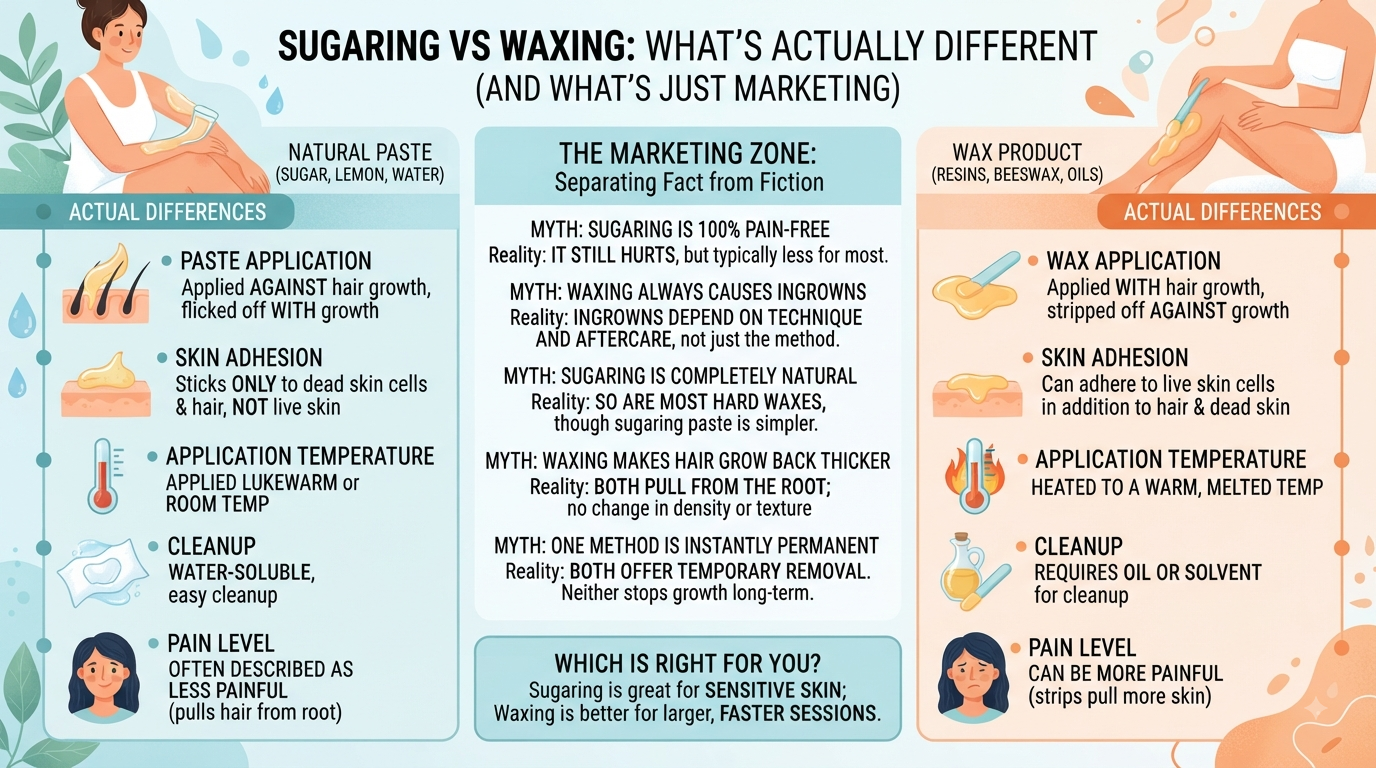
Search "sugaring vs waxing" and you'll notice something quickly: nearly every result is published by a salon that specialises in one or the other. Sugaring pages declare sugaring superior; waxing pages return the favour. Since sugaring typically costs £5–£10 more per area in the UK, it's worth knowing which differences are real mechanics and which are marketing. Here's the neutral version.
The mechanical difference (this part is genuinely real)
Both remove hair from the root. The difference is direction and adhesion.
Waxing: wax is applied in the direction of hair growth and removed against it. Wax adheres to both hair and live skin cells, which is where the sting comes from — you're also pulling at the top layer of skin.
Sugaring: the paste is applied against the growth direction and flicked off with it. Sugar paste doesn't bond to live skin cells — it grips hair and dead skin only. It's also applied at body temperature rather than heated.
Those two facts — removal direction and skin adhesion — are the basis of most legitimate sugaring claims, and they're not marketing. They're just how the two products behave.
Claim by claim: what holds up
"It hurts less" — partly true, but it's a different sensation rather than a painless one. Less skin adhesion means less of the stinging that comes from wax pulling at live skin. But hair is still being removed from the root, and that fundamentally hurts. People used to waxing often describe sugaring as a duller, more spread-out sensation rather than the sharp three-second rip. Which you find worse is genuinely personal.
"Fewer ingrown hairs" — plausible mechanism, widely reported. Removing hair with the growth direction causes less breakage, and broken hairs with sharp ends are a common ingrown cause. Sugaring also exfoliates dead skin as it goes. This is the most credible advantage, though it's worth saying the evidence is mechanistic and anecdotal rather than from head-to-head trials.
"Better for sensitive skin" — reasonable. Body-temperature paste means zero burn risk, and less skin adhesion means less redness. If you react badly to hot wax, this is the strongest reason to try it.
"It's all natural — just sugar, lemon and water" — true, though 'natural' isn't automatically gentler. Plenty of natural substances irritate skin. The practical benefits here are real but specific: no synthetic resins to react to, and paste that dissolves in water rather than needing oil to remove residue.
"The hair stops growing back" — no. Neither method permanently removes hair. Regrowth does become finer over years of consistent removal from the root, with either method. Anything beyond that is laser territory.
Where waxing genuinely wins
This half rarely appears on sugaring sites:
- Thick, coarse hair. Wax grips more strongly and is more likely to clear every strand in one pass; sugaring can miss coarser hairs, meaning more passes.
- Speed. A therapist can wax legs in around 20 minutes with strips. Sugaring's mould-and-flick technique is slower over large areas — which is part of why it costs more.
- Availability. Almost every UK salon offers waxing; sugaring requires specific training and is far less widespread outside cities.
- Very long regrowth. If you've left it months, wax handles length better — sugaring gets uncomfortable much beyond half an inch.
The hair length difference (the underrated selling point)
Sugaring can grip shorter hair than wax — around 2mm versus the 3–5mm most waxing needs. For anyone who finds the grow-out phase the worst part of waxing, that's a smaller and genuinely useful advantage: a shorter awkward window between appointments. It's rarely the headline claim, but for regular clients it's often the one that matters most day to day.
What it costs in the UK
Expect sugaring to run roughly £5–£10 more per area than the equivalent wax, reflecting the slower technique and less common training. Against typical UK waxing prices — check current rates on our full leg, Brazilian and Hollywood price pages — that's meaningful over a year of monthly appointments, so it's worth trialling one area before switching everything.
So which should you book?
Try sugaring if you have sensitive skin or react to hot wax, you're prone to ingrown hairs, you have finer hair, or the grow-out length between appointments is your main frustration.
Stick with waxing if you have thick coarse hair, you want large areas done quickly, availability matters, or you're happy with your current results — there's no reason to pay more to fix something that isn't broken.
Whichever you choose, the prep and aftercare rules are identical: exfoliate 48 hours before not on the day, arrive with clean product-free skin, and avoid heat for 24–48 hours after. Our guide to hard wax vs soft wax covers the comfort differences within waxing itself, which for many people matters more than switching method entirely.
The bottom line
Sugaring's core claims — less skin trauma, fewer ingrowns, no burn risk, shorter hair length needed — rest on genuine mechanical differences, not just marketing. But it's slower, costs more, works less well on coarse hair, and doesn't stop hair growing back any more than waxing does. If you're happy with your waxing, stay. If ingrowns or sensitivity are your recurring problem, sugaring is a reasonable £5–£10 experiment on one area.
Find a verified waxing or sugaring specialist near you in our directory, or check current UK hair removal prices on our Beauty Price Index.
Ready to book waxing & hair removal?
Check typical UK prices, then find a verified local pro.