Ads
☀️
Summer is here! Holiday-ready nails, lashes and glow — share your looks.
Glass Skin, Cloud Skin, Latte Makeup: How to Actually Translate Viral Terms When Booking a Makeup Artist
 Roylina Team
Gold · 2,654 lifetime points
Verified UK Pro — qualified & insured
Premium Lovers account
Premium Gold account
1 hour ago
6
4 min
Roylina Team
Gold · 2,654 lifetime points
Verified UK Pro — qualified & insured
Premium Lovers account
Premium Gold account
1 hour ago
6
4 min
Also Read:
Moved cities and lost my entire beauty "team" — how do you actually find new people you trust?
Ads
Here's a conversation happening in makeup chairs across the country: a client says "I want cloud skin for the wedding," the artist nods, and both people are now picturing slightly different things. Not because anyone's wrong — but because viral makeup terms describe a finish in a fifteen-second video, not a brief a professional can work from. The tutorials teach you to do the look on yourself with specific products; none of them teach you how to ask someone else for it. So here's the translation layer.
Why trend names make bad briefs
Trend vocabulary isn't standardised. "Cloud skin" was coined by a MAC artist to describe a soft-focus matte technique that's existed on red carpets for decades — but ask five artists and you'll get five interpretations of how matte, how glowy, how blurred. Same for glass skin (does the client mean the skincare-heavy Korean original, or just "very dewy"?) and latte makeup (a warm monochrome vibe with no fixed rules at all). A professional MUA has almost certainly heard every one of these terms — the risk isn't that they don't know them, it's that their mental image was built from different reference photos than yours.
The decoder: what each term means in artist language
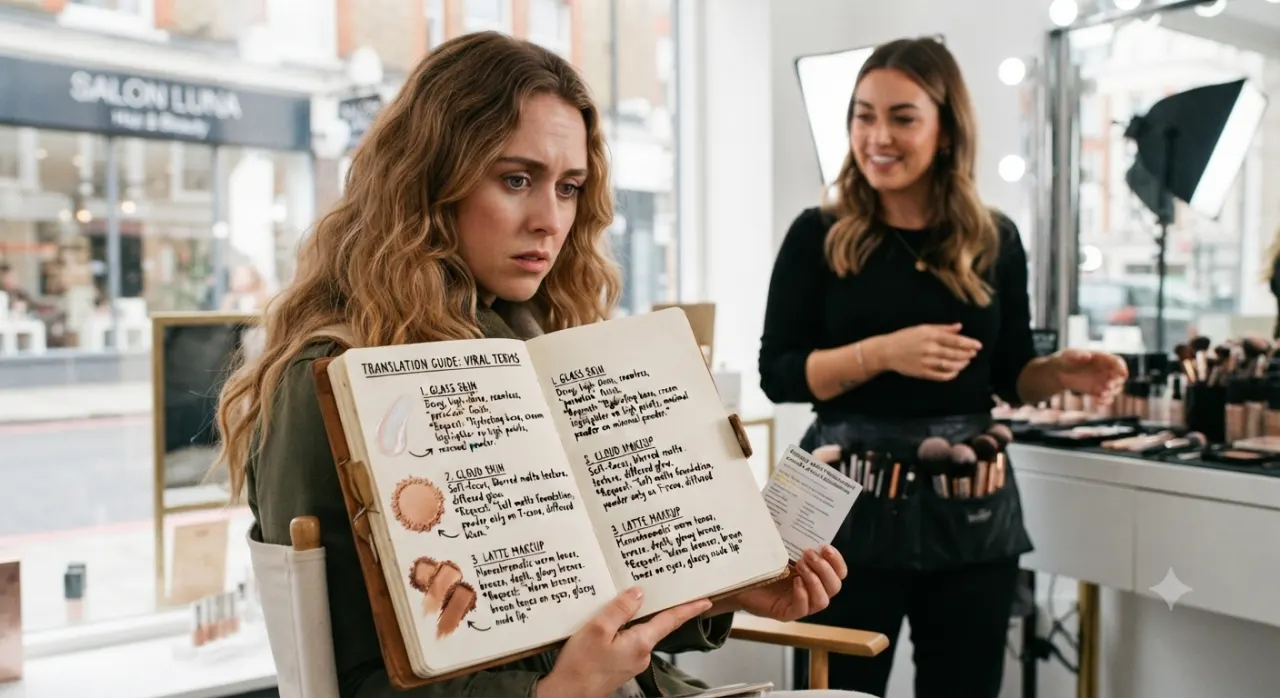
Glass skin → "maximum dewy, skin-first, minimal powder." You're asking for intense hydration prep, thin layers of luminous base, and shine treated as the feature rather than the enemy. Honest caveat your artist may raise: true glass skin is 70% skincare and skin condition — if your skin is textured or oily, they may steer you toward a modified version, and that's expertise, not a downgrade.
Cloud skin → "soft matte with glow underneath — blurred, not flat." The brief is: no hard shimmer highlighter, powder only where needed, everything diffused. The keyword that lands with artists is soft focus. If you say "matte" alone, you risk getting the full-coverage flat matte of 2016 — the "but still luminous" half of the sentence is doing the important work.
Latte makeup → "warm-toned monochrome — bronze, caramel and brown tones on eyes, cheeks and lips, nothing cool or pink." This one translates well because it's really a colour story, not a technique. Useful add-on: say whether you want the shimmery-lid version or the fully matte version, because both live under the same hashtag.
"Clean girl" makeup → "skin-like base, brushed-up brows, cream blush, barely-there everything." The trap here is that "natural makeup" takes as much product and skill as glam — it's not a cheaper or quicker booking, and artists quietly wince when it's assumed to be.
Soft glam → the most-requested and least-defined term of all. To one artist it's a neutral smoky eye with lashes; to another it's a full sculpted base. This is the one where reference photos aren't optional.
The three-part brief that beats any trend name
Whatever the look is called this month, artists consistently say the same three inputs produce the right result:
- Two or three photos, ideally on someone with your colouring and features — a look screenshotted from a model with completely different skin tone or eye shape translates loosely, not literally. And photos of yourself wearing makeup you loved are worth more than any influencer reference.
- The finish, in plain words: how shiny (dewy / soft / matte), how much coverage (skin showing through / medium / full), and one thing you hate (e.g. "nothing glittery," "no heavy contour"). The dislikes are genuinely more useful to an artist than the likes.
- The context: photos all day? Crying likely? Hot venue? Wearing it for 14 hours? These change product choices more than the trend name does — and it's exactly the conversation a trial exists for, which is why our bridal trial guide treats the trial as a working session, not a preview.
One more translation tip: ask what they'd call it
A genuinely useful move at consultation: show your reference photos and ask the artist, "what would you call this look?" Their answer tells you two things at once — whether you're picturing the same thing, and how they think about their work. An artist who looks at your cloud skin screenshot and says "so, a diffused matte base with cream blush and no shimmer" is someone who's translated the trend into technique. That's who you want holding the brush.
The bottom line
Viral terms are a fine starting point — they get you both in the right neighbourhood. But the booking that goes right is the one where the trend name is followed by photos, a plain-words finish description, and your dislikes. The name gets the conversation started; the brief gets you the face you actually pictured.
Find a verified makeup artist near you in our directory, or check current UK pricing for makeup services on our Beauty Price Index.
Choice Community
0 Comments
Join the conversation.
Log in to comment
No comments yet. Be the first to share your thoughts.
More from General Chat
Ads
Ads