Ads
The HydraFacial for Your Scalp Is a Real Thing Now — Here's What Keravive Actually Does
 Roylina Team
Gold · 4,110 lifetime points
Verified UK Pro — qualified & insured
Premium Lovers account
Premium Gold account
2 months ago
189
4 min
Roylina Team
Gold · 4,110 lifetime points
Verified UK Pro — qualified & insured
Premium Lovers account
Premium Gold account
2 months ago
189
4 min
Also Read:
Added up what I spend on beauty in a year and I've been sat here in silence for ten minutes
"Skinification" of hair care has been building for a couple of years — scalp serums, scalp SPF, scalp exfoliators — and it was only a matter of time before the treatment menu caught up. Enter HydraFacial Keravive: the same vortex-suction technology behind the famous facial, redirected at your scalp. It's one of the fastest-growing salon requests in the "scalp health" wave, and like most treatments having a moment, the marketing is running slightly ahead of the explanations. Here's what it actually is.
What a scalp HydraFacial actually involves
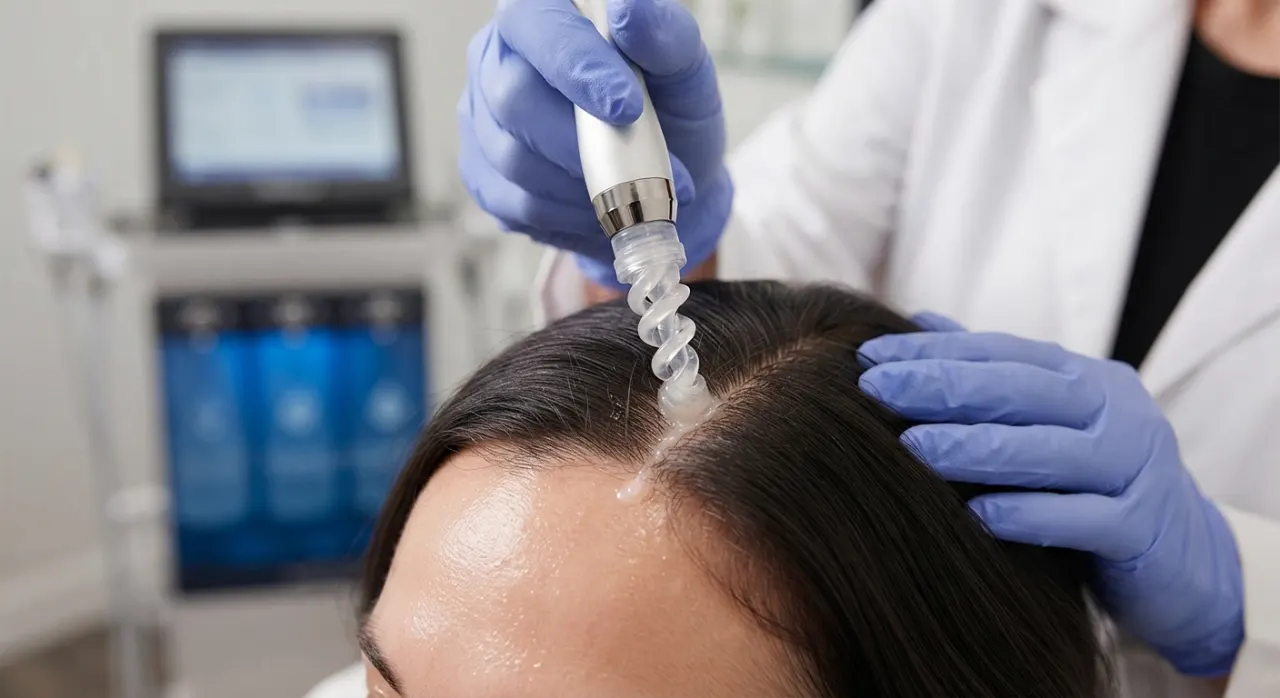
Keravive uses the same core technology as the facial version — vortex suction combined with liquid infusion — but with the process and serums tailored to the scalp. The treatment runs in three steps: first, gentle suction and exfoliation cleanse the scalp and open up hair follicles, pulling out oil, dead skin and product buildup; second, the scalp is infused with a peptide complex — a blend of peptides, growth factors and skin proteins designed to hydrate and nourish the follicles; third, you take home a daily peptide spray to keep the process going between sessions.
The session itself takes roughly 30–45 minutes, is completely painless (most people describe gentle suction and a cooling sensation — several report it's genuinely relaxing), and has zero downtime beyond needing to restyle your hair. The one practical rule: don't wash your hair for 6–12 hours afterwards, so the serums fully absorb.
Who it's actually for
The honest framing: this is a scalp health treatment, not a hair loss cure. It's aimed at dry, flaky or itchy scalps, oily buildup, clogged follicles, and dull or thinning hair where the underlying issue is scalp condition rather than genetics or hormones. The logic is sound — hair grows better from a clean, hydrated, well-circulated scalp — and the reported results back that up for scalp comfort and hair fullness: in the brand's own data, around half of clients report fuller-feeling hair after a single session, with the best results after a course.
What it won't do is reverse pattern hair loss on its own. If genuine hair loss is your concern, this sits in the "supporting treatment" category — some clinics pair it with medical hair restoration approaches precisely because a healthier scalp improves the environment those treatments work in. Going in expecting a thinning-reversal miracle from a scalp facial alone is how disappointed reviews happen.
The course-based catch (same story as the facial version)
Like most treatments in this category, the meaningful results come from a course, not a one-off: the standard recommendation is three sessions spaced a month apart, with the daily take-home spray in between, followed by maintenance every few months. One session will leave your scalp feeling noticeably cleaner and your hair softer — a pleasant result, but a temporary one. If you're budgeting, budget for the course.
Pricing in the UK varies significantly by clinic and whether the take-home spray is bundled in — it sits at the premium end of scalp treatments, broadly in line with facial HydraFacial pricing and often above it. Ask specifically whether the 30-day spray is included in the quoted price, since that's a meaningful chunk of the treatment's value. You can compare against standard HydraFacial pricing near you as a reference point, and our pricing calculator can help you work out the full three-session course cost.
A few practical points worth knowing
- It's safe for colour-treated and keratin-treated hair — the treatment doesn't affect dye or smoothing treatments.
- Extensions, braids and locs are fine too — the treatment and spray can be used with bonded or tape-in extensions and protective styles.
- Come with clean-ish, product-free hair if you can — heavy styling product on the day just gives the first step more to clear before the useful work starts.
- Active scalp infections mean rescheduling — a reputable clinic will check this before treating.
Worth it or hype?
Both, in the way most trend treatments are. The underlying idea — treating your scalp with the same seriousness as your face — is legitimate and overdue; flaky, congested or dehydrated scalps genuinely do affect how hair looks and behaves. Whether the premium price is worth it over a good clarifying routine depends on how real your scalp concerns are. If you've got persistent dryness, buildup or dullness that home care hasn't shifted, a course makes sense. If your scalp is fine and you're just curious, a single session is a pleasant experience that won't change your life — and that's a perfectly reasonable thing to know before you spend the money.
Find a verified specialist offering scalp treatments near you in our directory, or browse current UK treatment pricing on our Beauty Price Index.
Choice Community
0 Comments
Join the conversation.
Log in to comment
No comments yet. Be the first to share your thoughts.