Bad Haircut or Botched Treatment? Your Actual UK Consumer Rights (and What to Say)
6 min read · Updated 16 Sep 2026
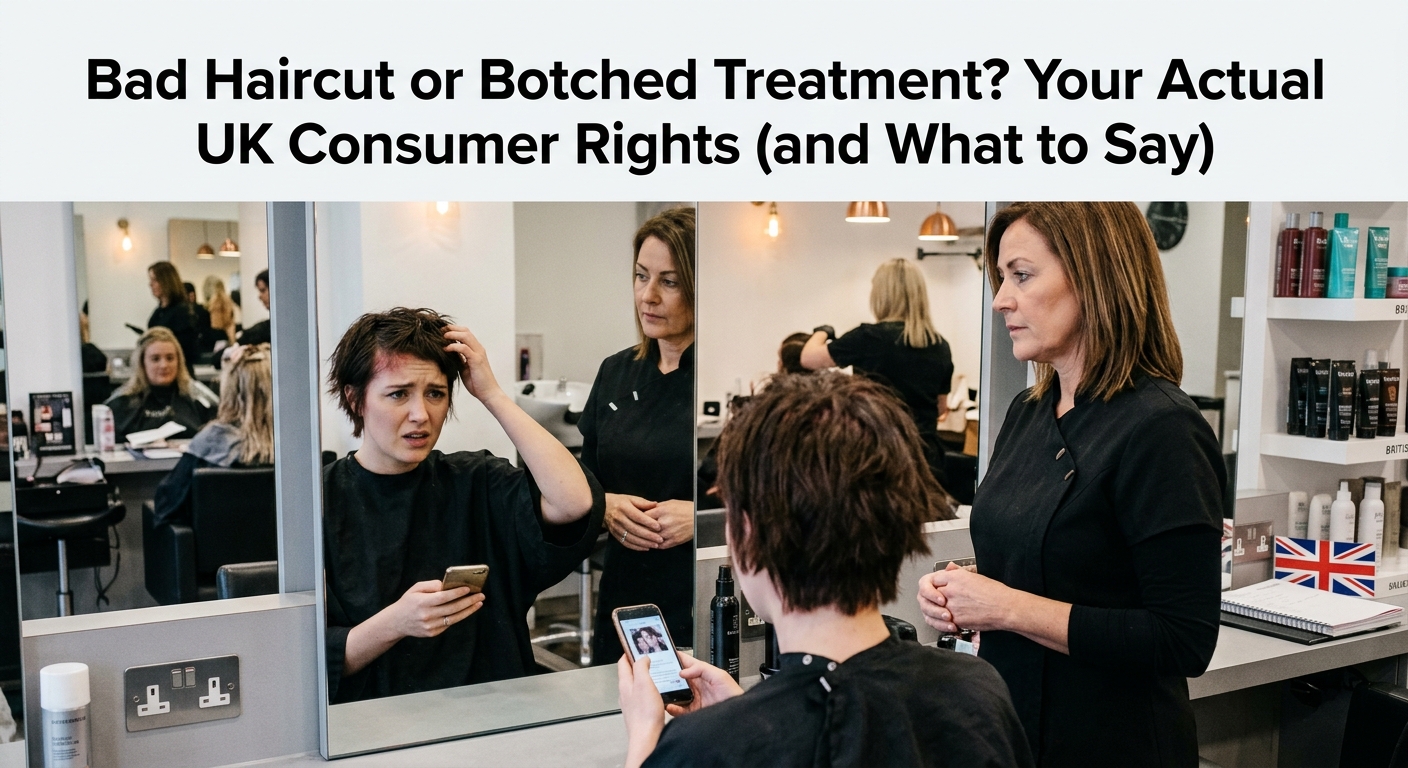
You've paid for something that went wrong, you feel awkward about complaining, and you're not sure whether you even have a case. Most articles on this either tell you to "know your rights" without specifics, or are written for salon owners rather than clients. Here's the practical version — including the honest part about where the line actually sits.
Worth saying upfront: this is general information rather than legal advice, and anything serious — injury, a large sum, a dispute that escalates — is worth taking to Citizens Advice or a solicitor.
The law in one sentence
Under the Consumer Rights Act 2015, a service must be carried out "with reasonable care and skill" and match what was agreed. If it wasn't, the provider must put it right at their own cost within a reasonable time. If that isn't practical, you should get some or all of your money back within 14 days of a refund being agreed.
The bit almost nobody knows: repeat performance comes first
This is the single most important mechanic, and getting it wrong is how people lose otherwise-good claims.
The law sets out an order of remedies. Repeat performance — the salon redoing the service, free, within a reasonable time — is the first remedy to exhaust. A price reduction or refund only becomes available if repeat performance is impossible, or the salon failed to deliver it within a reasonable time or without significant inconvenience to you.
In practice: if you walk out, go straight to another salon, pay to fix it, and then demand a refund from the first one, you've skipped the step the law required. Give them the chance to fix it — even if you'd rather not — because it's what makes everything after it enforceable.
One useful protection: if you've lost confidence in the person who did it, it's reasonable to ask for a different stylist or therapist to carry out the repeat performance.
Where the honest line sits
Not every disappointing result is a legal claim, and it's worth knowing which side you're on.
Likely a valid claim: the service isn't what was agreed (you asked for a trim, they took six inches); technical failure (breakage, burnt scalp, chemical damage); or negligence such as skipping a required patch test or not asking about allergies.
Probably not: "it's technically what I asked for but I don't love it." Subjective dissatisfaction with a competently executed service isn't a breach of the Act. Uncomfortable, but true.
The grey area — and it's common: you brought a photo, they said it was achievable, and it wasn't. This often comes down to whether the result was technically deliverable in one appointment from your starting point. A colourist who says "yes, absolutely" to a big lightening job without flagging that it needs two sessions has arguably failed on the "as agreed" limb. This is exactly the scenario in a discussion in our community, and it's worth reading the responses.
What to do, in order
- Say something while you're still there, if you can. It's the easiest moment for everyone, and salons overwhelmingly prefer fixing it to losing you.
- Take photos, straight away and in daylight. Evidence gets harder to produce with every day that passes.
- Go back as soon as possible if you didn't raise it on the day. Delay weakens your position — both legally and practically.
- Put it in writing if the conversation doesn't resolve it. Email creates a record; a doorstep conversation doesn't.
- If you do go elsewhere after they've refused, tell the new professional what happened and ask for their assessment in writing. That's your evidence of what fixing it cost.
The wording that works
Vague complaints ("I'm unhappy") invite defensiveness. Specific ones invite solutions. Something like:
"Hi — I came in on [date] for [service] and asked for [specific thing], and the result is [specific difference]. Under the Consumer Rights Act I'd like to give you the opportunity to put it right. Could we arrange that? I'd prefer a different stylist if possible, purely because I'd feel more comfortable."
That works because it's dated, specific, cites the relevant law without threatening, and asks for the remedy the law actually requires first.
If they refuse: how to escalate
- NHBF mediation. If the salon is an NHBF member, their Hair & Beauty Mediation service is a certified ADR scheme. You pay £12, the salon pays £30 — and your fee is refunded if they refuse to take part. You can apply directly if a member salon hasn't responded within eight weeks. Note: it excludes injectables and anything needing a Level 6/7 qualification.
- The Hair Council, if the salon is registered with it — they can take up complaints and, in serious cases, deregister.
- Trading Standards, via Citizens Advice, particularly where there's a pattern of behaviour rather than a one-off.
- Small claims court for genuine financial loss — realistically the cost of putting it right elsewhere, not compensation for distress.
- Card chargeback or Section 75 if you paid by card — worth asking your bank about, and one of several reasons paying by card beats cash for anything substantial.
If you were actually injured
Different route. Burns, allergic reactions, chemical damage or scalp injury caused by negligence — a missed patch test being the classic example — can support a personal injury claim, with a limitation period of three years from the incident or from when the injury came to light. Get medical attention first and keep records; that's both the right thing for your health and what any claim would rest on.
How to avoid needing any of this
Most disputes trace back to the consultation rather than the service. Three habits that prevent nearly all of them: bring reference photos and ask directly "is this achievable today, from where my hair is now?"; ask what happens if you're not happy, before you commit; and check credentials and insurance first — our guide to checking whether your therapist is actually qualified covers the one message that does it.
The bottom line
You have real rights under the Consumer Rights Act 2015 — but the salon gets to fix it first, and skipping that step is the most common way people weaken their own case. Raise it early, be specific, take photos, put it in writing, and escalate to NHBF mediation or Trading Standards if you're refused. And be honest with yourself about which side of the "not as agreed" versus "not to my taste" line you're actually on.
Find a verified hairdresser or beauty professional near you in our directory, or compare current UK treatment prices on our Beauty Price Index.