BIAB vs Gel vs Acrylic vs Dip Powder: Which Nail Treatment Actually Suits You?
5 min read · Updated 5 Aug 2026
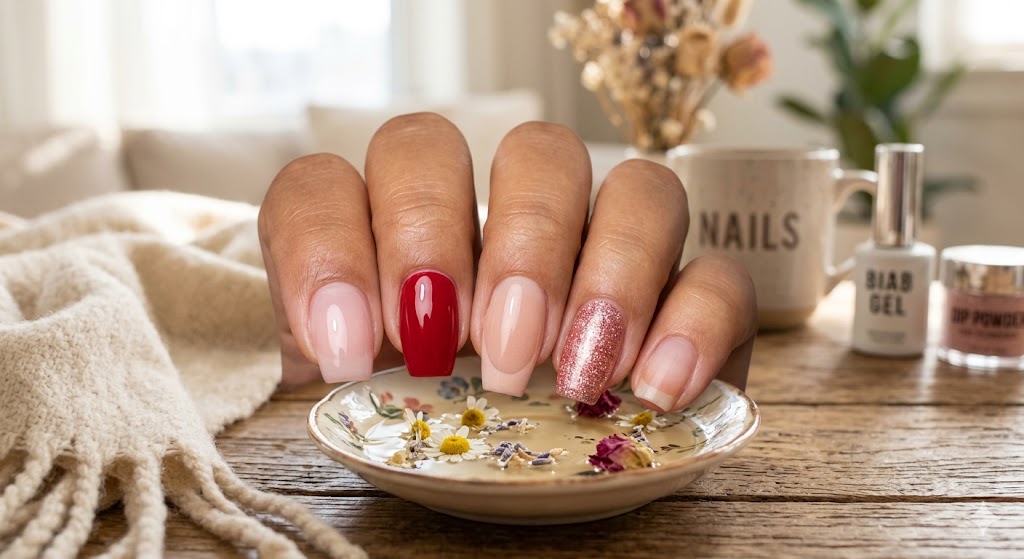
If you've stood in front of a salon menu trying to decide between BIAB, gel, acrylic and dip powder, you're not alone. Every nail tech on TikTok seems to have a different opinion, half the comparison articles online just describe the chemistry and never actually tell you which one to book, and the other half are clearly written by someone who's never had a single one of these on their own hands.
So let's actually sort this out properly. Here's what each one is, what it costs across the UK right now, how long it really lasts (not the optimistic salon-poster version), and which one fits your nails, your lifestyle and your budget.
The short version, if you're in a rush
- Weak, bendy or bitten nails that you want to grow out → BIAB
- Strong natural nails, want quick low-maintenance colour → Gel
- Want serious length or have to fix a broken nail fast → Acrylic
- Want colour and some strength without a UV lamp → Dip powder
If that's enough for you, great. If you want the actual reasoning (and the numbers to back it up), keep reading.
What each one actually is
Gel manicure is the one most people already know. A gel polish is brushed on in thin layers and cured under a UV or LED lamp between coats. It's flexible, glossy, and sits close to the natural nail, so it feels light. There's no extension involved unless you ask for tips.
BIAB stands for Builder Gel In A Bottle — basically a thicker, stronger gel that's applied straight onto your natural nail. It builds a protective layer over the nail rather than just colouring it, which is why nail techs reach for it when someone's nails are thin, peeling, or have been wrecked by years of acrylic. It still cures under a lamp, same as gel.
Acrylic is a different chemistry altogether — a liquid monomer mixed with a powder polymer that hardens in the air rather than under a lamp. This is what gives acrylics their reputation for being rock solid and good for adding real length, since the product can be sculpted over a form or tip before it sets.
Dip powder sits somewhere between gel and acrylic. Your nail gets a base coat, then it's dipped into coloured powder, sealed with an activator, and built up in a few layers. No lamp needed at any point, which some people genuinely prefer.
How they actually compare
BIAB Gel Acrylic Dip Powder
| Cures under UV/LED lamp | Yes | Yes | No (air-dries) | No
| Good for length/extensions | Limited | Limited | Best option | Some
| Typical lasting time | 3–4 weeks | 2–3 weeks | 2–3 weeks (needs infill) | 2–3 weeks
| Feel on the nail | Natural, flexible | Lightest | Hardest, most rigid | Medium
| Best for | Weak/damaged nails | Strong natural nails | Length & strength | Colour without a lamp
A quick myth to clear up: acrylics don't ruin your nails on their own. Damage almost always comes from rough removal — someone ripping them off or aggressively filing through the nail plate, rather than soaking off properly. The same goes for BIAB and gel; bad removal is the actual villain, not the product.
What it actually costs in the UK right now
Pricing varies a lot by region and salon, but here's what people are currently paying across the UK, based on real submitted pricing data:
- BIAB: around £44.63 on average
- Gel manicure: around £46.29 on average
- Acrylic full set: around £49.17 on average
- Acrylic infill: around £49 on average
- Dip powder: around £55.84 on average
- Gel removal: around £46.79 on average
A few things worth knowing before you book:
- Infills change the maths. Acrylic and BIAB both need infills roughly every 3–4 weeks, and that's usually priced separately from your first full set. Add that into your real monthly cost, not just the one-off price — our infills guide breaks down how often you actually need one and what they cost.
- Dip powder is currently the priciest of the four in the data we're seeing, which surprises a lot of people who assume it's the "budget" option because there's no lamp involved.
- Removal isn't always included. Some salons fold gel removal into the price of your next set if you're rebooking with them; others charge it separately every time. Always ask before you sit down.
Curious what's typical in your specific city rather than the UK-wide average? Our price index breaks pricing down by treatment and location, and you can run your own numbers with the pricing calculator if you're trying to budget out a few months of upkeep.
So which one should you actually pick?
Go with BIAB if your nails are thin, peeling, or you bite them and want something protective rather than just decorative. It's the closest thing to a "nail recovery" treatment that still looks polished.
Go with gel if your natural nails are already in decent shape and you mainly want colour without the commitment of an extension. It's also the quickest in and out of the chair.
Go with acrylic if you want real length, a specific sculpted shape, or you've snapped a nail and need a strong fix that isn't going anywhere for weeks.
Go with dip powder if you like the idea of a bit of extra durability and colour, but you'd rather skip sitting under a UV lamp.
None of these is objectively "the best" — they're suited to different starting points and different goals. If you're really not sure, ask whoever's doing your nails to look at your natural nail condition first. A good tech will steer you toward the right one rather than upselling whatever's most expensive on the menu.
Prices shown are UK averages based on data submitted to our Beauty Price Index and will vary by salon and region. Have a price to add? You can submit it here to help keep the index accurate.